
Join our Telegram group and receive breaking and trending news updates directly on your phone.
Join for News Updates ✕I Was Student Union Leader in 1992, Not Sure Umahi Had Finished University Then’ – Sowore Slams Works Minister Over Ohiri Assault
Tags: I Was Student Union Leader in 1992, Not Sure Umahi Had Finished University Then' – Sowore Slams Works Minister Over Ohiri Assault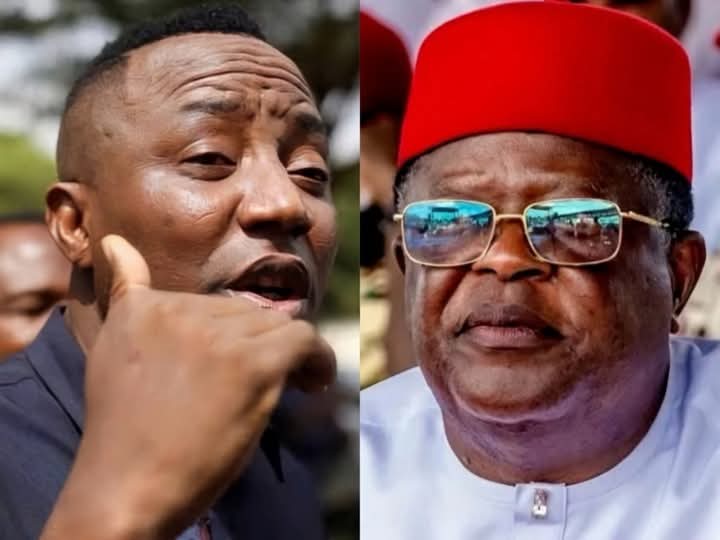
‘I Was Student Union Leader in 1992, Not Sure Umahi Had Finished University Then’ – Sowore Slams Works Minister Over Ohiri Assault
Prominent human rights activist and former presidential candidate, Omoyele Sowore, has fired back at the Minister of Works, Senator Dave Umahi, accusing him of disrespect and evasion after a heated confrontation over the alleged physical assault on Nigerian businesswoman, Tracynither Nicolas Ohiri.
Sowore, who detailed the encounter during a media appearance on Symfoni TV, recounted walking in on Umahi in the midst of questioning and harassing the woman with police backing, a scene that escalated dramatically when the minister spotted him and promptly attempted to flee.
“He was questioning and harassing the lady with the aid of the police. We walked in on that, and the moment he saw us he started running away. So I walked across and said, ‘Mr. Minister!’ And the moment he saw me, which is typical of them, he assumed that every Nigerian who comes across them is looking for something.
He said, ‘Come and see me if you want to talk,’” Sowore narrated, capturing the minister’s instinctive response rooted in a presumed culture of entitlement among public officials.
Dismissing the minister’s invitation outright as an act of condescension, Sowore emphasized his longstanding credentials in activism and leadership, underscoring why he had no business deferring to Umahi’s office.
“Look at this man, what would I need to see you in your office for? I was a student union leader in 1992. I’m not sure Umahi had finished university by then. So why would I come and see you in your office? For what? You are doing something wrong, let’s settle it here,” the activist declared with characteristic bluntness, positioning the exchange as a direct challenge to the minister’s authority rather than a subordinate plea.
The confrontation quickly turned physical, Sowore revealed, as Umahi’s loyalists surged forward and began attacking him moments later, highlighting the volatile tensions that often accompany public accountability efforts in Nigeria’s political landscape.
He was equally forthright in addressing his involvement in Ohiri’s case, rejecting any insinuations of personal financial motives and framing his intervention as a principled stand against impunity by those in power.