
Join our Telegram group and receive breaking and trending news updates directly on your phone.
Join for News Updates ✕Nafiu Bala vs. David Mark: Supreme Court’s Verdict Awaited Amid Established Legal Precedents
Tags: Nafiu Bala vs. David Mark: Supreme Court’s Verdict Awaited Amid Established Legal Precedents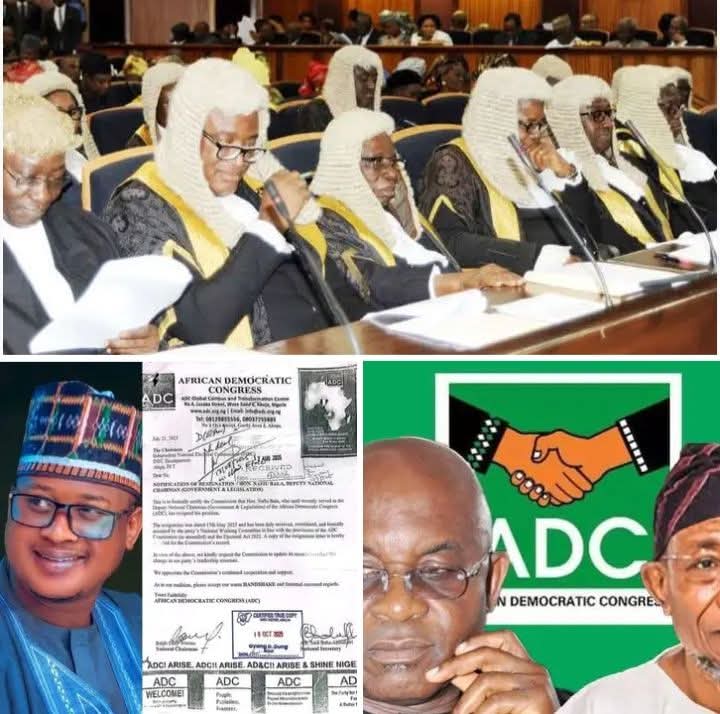
Nafiu Bala vs. David Mark: Supreme Court’s Verdict Awaited Amid Established Legal Precedents
By Yahaya Idris
As the legal battle between Nafiu Bala and David Mark, both laying claim within the African Democratic Congress (ADC), progresses toward final determination at the Supreme Court, attention has turned to a long line of judicial precedents guiding party internal disputes in Nigeria.
Legal observers note that the apex court has consistently maintained a cautious stance in matters relating to the internal affairs of political parties, often declining jurisdiction in disputes involving leadership, membership, and candidate nomination.
In Usman v. Labour Party (2025), the Supreme Court nullified an appellate court decision on party leadership, reaffirming that such disputes remain strictly internal. Similarly, in Anyanwu v. Emmanuel & Ors (2025), the court described issues of leadership and membership as “no-go areas” for judicial intervention.
This position was reinforced in Kabir v. APC (2024), where the court emphasized that political parties, as voluntary associations, possess supreme authority over their domestic matters.
The ruling in Abdullahi v. Argungu (2023) further reiterated the judiciary’s lack of jurisdiction in party leadership and administrative issues.
Even in election-related disputes, the court has drawn clear boundaries. In Mutfwang v. APC (2024), it held that nomination processes fall within the internal mechanisms of political parties and are generally not justiciable.
Earlier landmark rulings have also shaped this doctrine. In Onuoha v. Okafor (1983), the court established that candidate sponsorship is a political question beyond judicial reach.
This principle was reaffirmed in Dalhatu v. Turaki (2003), which held that courts lack jurisdiction over intra-party disputes.
Further strengthening this line of authority, Lado v. CPC (2011) maintained that candidate nomination is strictly a domestic party affair, while PDP v. Sylva (2012) confirmed that courts cannot impose candidates on political parties. In the same vein, Emenike v. PDP (2012) upheld the principle that judicial bodies must not interfere in how parties manage their internal conflicts.
With these precedents in focus, political analysts and stakeholders continue to watch closely as the Supreme Court prepares to deliver its judgment in the ADC dispute. Whether the court will uphold its long-standing position or chart a different course remains to be seen.