


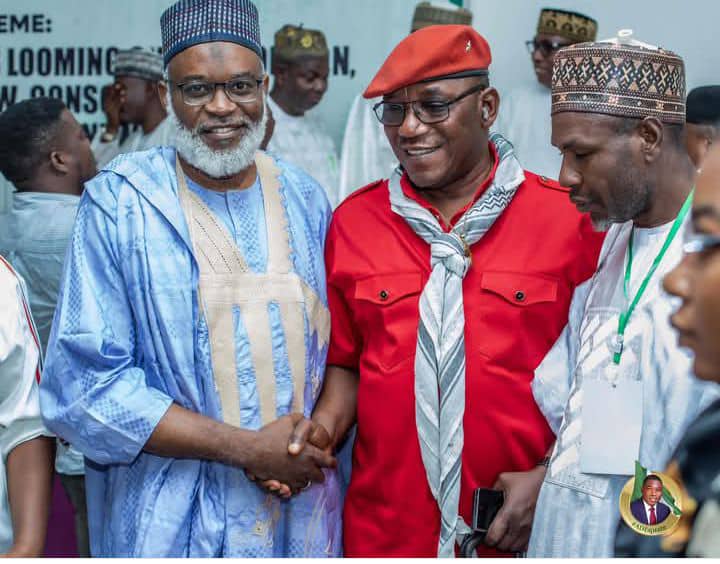
The covenant of Christians with Prophet Muhammad (PBUH): A Forgotten Charter of Harmony — Solomon Dalung
In the year 628 CE, at the foot of Mount Sinai, Prophet Muhammad (Peace Be Upon Him) extended a profound covenant to the Christian monks of St. Catherine’s Monastery, a document that has endured for over a millennium as a testament to religious freedom, mutual respect, and the sanctity of human dignity.
Preserved through the ages, this charter stands as a beacon of interfaith harmony, one that renowned Islamic scholar Dr. Muqtedar Khan hails for its enormous potential to reshape Muslim attitudes toward Christians, noting that Muslims generally revere the precedents set by their Prophet and strive to embody them in daily life.
At its core, the Prophet’s message rings with timeless clarity: “This is a message from Muhammad ibn Abdullah, as a covenant to those who adopt Christianity, near and far.
We are with them. Verily I, the servants, the helpers, and my followers defend them, because Christians are my citizens; and by Allah! I hold out against anything that displeases them. No compulsion is to be on them.
Neither are their judges to be removed from their jobs nor their monks from their monasteries. No one is to destroy a house of their religion, to damage it, or to carry anything from it to the Muslims’ houses.
Should anyone take any of these, he would violate God’s covenant and disobey His Prophet. Verily, they are my allies and have my secure charter against all that they hate. No one is to force them to travel or to oblige them to fight.
The Muslims are to fight for them. If a Christian woman is married to a Muslim, it must be with her consent. She must not be prevented from attending her church to pray. Their churches must be respected and never hindered from repair.
Their sacred covenants must remain inviolate. No one of the nation (Muslims) is to disobey this covenant until the Last Day (end of the world).”
What makes this covenant truly remarkable is its unconditional nature, imposing no demands on Christians to alter their beliefs, pay tribute, or swear fealty to any Islamic authority—simply by virtue of their faith, they were granted full protection under Islamic law, extending not just to the monks of one monastery but to all who adopt Christianity, “near and far,” as the Prophet explicitly declared.
The opening and closing clauses elevate it beyond a mere historical pact into a spiritual imperative for all Muslims, an eternal commitment where any violation constitutes not only a legal breach but a direct affront to God’s own covenant, as affirmed by the Prophet himself.
Though penned in the 7th century, its principles echo the very foundations of modern human rights—freedom of religion, safeguards for property and personal security, and the unassailable right to worship—offering a blueprint that, if more widely known and heeded by Muslims today, could profoundly bolster interfaith trust and harmony across divides that have grown perilously wide.
Yet this covenant is far more than a dusty artifact; it serves as a spiritual roadmap for peaceful coexistence in our fractured world, where sadly it is more often breached in spirit than upheld, even as Nigeria grapples with its own mosaic of religious diversity amid tensions that test the bonds of our nationhood. In a country like ours, blessed yet burdened by multiculturalism, where Christians and Muslims share streets, markets, and aspirations under one flag, leaders—especially religious ones—must rise to revive this culture of love, tolerance, and mutual respect, defeating the evil within by nurturing the good that resides in us all.
Religious texts and traditions, when interpreted through their truest lenses, wield moral power enough to forge peace rather than fuel division, and this charter stands as irrefutable proof that Islam, at its prophetic core, is a faith of protection, alliance, and justice toward others, not hostility.
It is high time we reclaimed these roots in Nigeria, living not as adversaries on a battlefield of faith, but as a people bound by shared destiny, honouring the Prophet’s pledge that unites rather than divides.
Dalung Faults Malami’s Arraignment, Demands Prosecution Of Terrorism Financiers
Solomon Dalung, LLM, LLB, BL
Garkuwan Arewa, Dike Egwureogwu & Igbarman Otarok
Voice of the Silent Majority
igbarman@gmail.com


Comments are closed